Elon Musk wants to sell humanity a ticket to a lead-lined box on a frozen rock 140 million miles away. He calls it the most inspiring future imaginable. Self-sustaining cities on Mars, Starships ferrying thousands of people, humanity finally becoming a multi-planetary species.
In the keynote recorded on March 21, 2026, in Austin, TX, Musk referenced Star Trek and other sci-fi works to justify his vision. Yet even in Star Trek, the crew doesn’t live 24/7 inside sterile metal corridors. They have the holodeck, which is a full-sensory simulation of real life, complete with beaches, forests, and open skies. It exists because prolonged isolation in artificial environments would drive people insane.
On Mars and the Moon, there will be no holodeck. There will only be the tube.
I have spent more than 20 years in the tech industry, most of them working fully remote. From home offices to the digital nomad trail, my life was defined by the desk and the monitor. I know exactly what tech burnout feels like: tight shoulders, dry eyes, and a brain that never fully switches off. At the end of every day I was wrecked. Eventually the failures and burnout forced a complete system reset.
That reset brought me to Thailand and led me to seek a real digital detox.
The Physics of the Cage
Humans are biological machines optimized for 1g, Earth’s magnetosphere, and full-spectrum sunlight.
On Mars you get:
- Only 0.38g → bones slowly dissolve, cardiovascular system weakens[01].
- No magnetosphere → constant lethal cosmic and solar radiation.
- No breathable atmosphere → every breath depends on machines.
Because of the extreme radiation, large windows are not realistic. Early habitats will be buried under meters of Martian regolith or thick shielding. Any view of the outside world will mostly be mediated by cameras and monitors.
OPERATOR NOTE: THE REGOLITH PROBLEM
On Earth, we have “soil”. It’s organic, soft, and weathered by wind and water. On the Moon and Mars, you have Regolith.
The Data:
- Zero Weathering: Because there is no wind or rain, regolith isn’t rounded down. Every grain is a jagged shard of volcanic glass and mineral fragments.
- The “Glass Lung” Risk: These particles are sub-micron in size and razor-sharp. Inhaling them isn’t like breathing dust; it’s like breathing pulverized glass. This can cause serious abrasion and long-term damage to lung tissue, while also rapidly fouling mechanical seals and accelerating wear[02][04].
- The Static Trap: Regolith is electrostatically charged by solar radiation. It doesn’t just sit there; it clings to everything from suits and airlocks to electronics, defying standard cleaning protocols.
- The Shielding Paradox: While it is lethal to touch, it is your only defense. Because it’s dense and readily available, a “habitat” must be buried under 3 to 5 meters of this material to survive the constant bombardment of cosmic radiation.
The Verdict: You don’t live on the regolith; you live under it. It is the primary building material of your lunar or Martian cage.
The Moon Base Reality Check
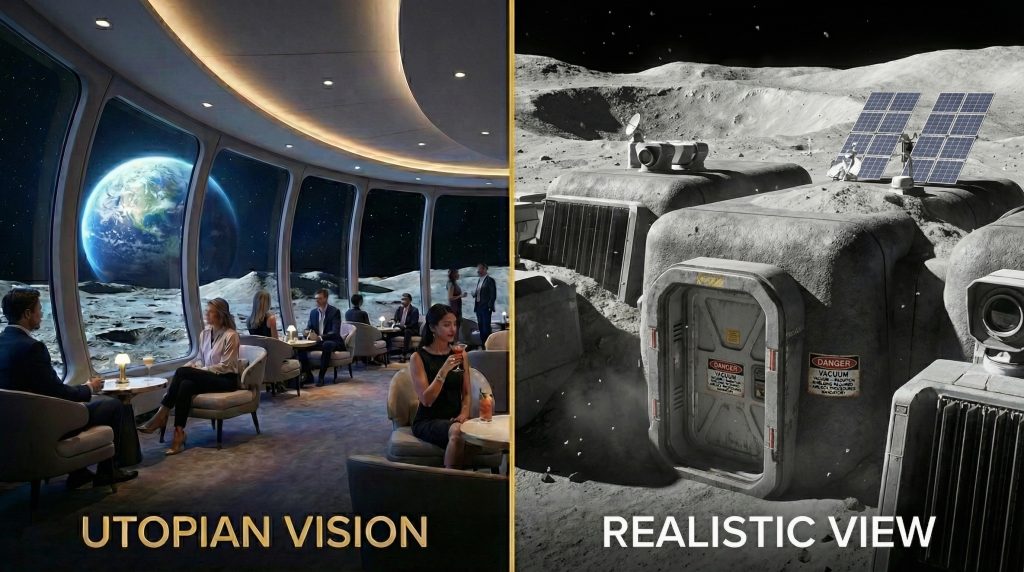
The same engineering constraints apply to the Moon, even though it’s closer and often shown with optimistic visuals.
Many concept images show beautiful Moon bases with large panoramic windows overlooking Earth. In reality, with current and near-term technology, this is highly unlikely.The Moon has no atmosphere and very weak magnetic protection. Solar flares and cosmic radiation remain a serious threat. Large glass surfaces are structural weak points and would require extremely thick, heavy radiation shielding. Serious lunar habitat designs mostly rely on buried modules, thick regolith shielding[03], and only small, heavily reinforced viewports at best.
The romantic vision of sitting by a big window watching Earth rise is mostly marketing. The tactical reality is a bunker with minimal direct visual connection to the outside.
Can humans survive long-term in Lunar or Martian regolith habitats?
Long-term survival is theoretically possible but biologically costly. While regolith provides essential radiation shielding, it lacks the full-spectrum sunlight, 1g gravity, and atmospheric pressure required for human hormonal and cardiovascular health. Real sovereignty requires natural systems that are currently only found on Earth.
The Ultimate Kill-Switch
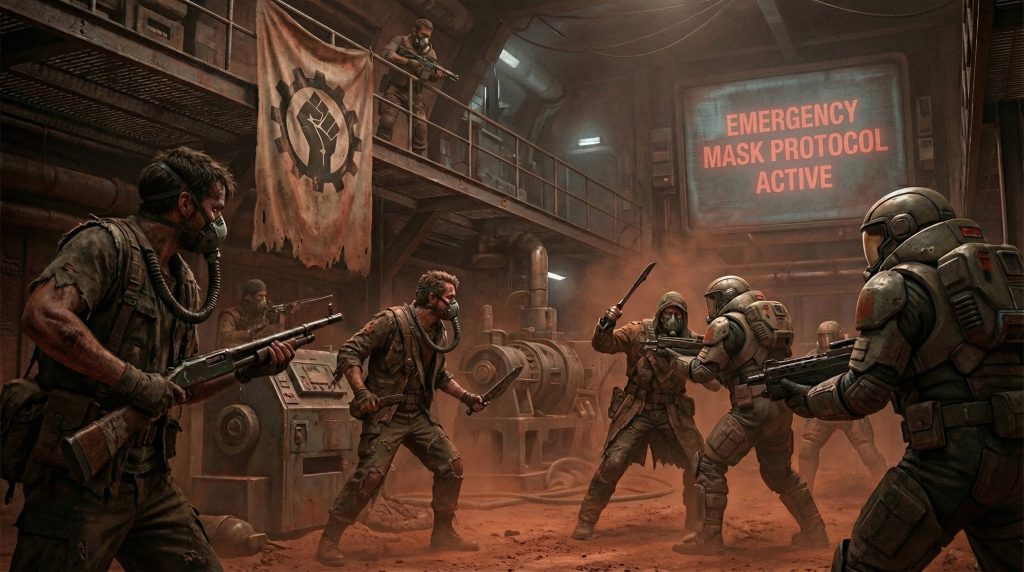
Remember the original Total Recall (1990) movie? When there was a rebelion, the authorities simply turned down the oxygen. That is not fiction, it is the logical outcome of any closed-loop life-support system.
On Mars or the Moon there is no digging a well, no true off-grid living. Your air, water, pressure, and power are all controlled centrally.
Disagree with those in charge? You don’t get canceled.
You get suffocated.
Your existence becomes a subscription service.
We Are Already Living “Mars Life” on Earth

The modern tech worker does not need a starship to experience this. The current baseline is a 12-hour low-fidelity simulation. Eyes locked on monitors, biological hardware deteriorating. The industry talks about open-source freedom while running on a Vitamin D deficiency.
When the work cycle ends, the standard “recovery protocol” is simply migrating to a secondary screen… Streaming, gaming, and social media. The nervous system never actually unplugs; it just switches data feeds.
The irony is loud.
What Real Sovereignty Looks Like
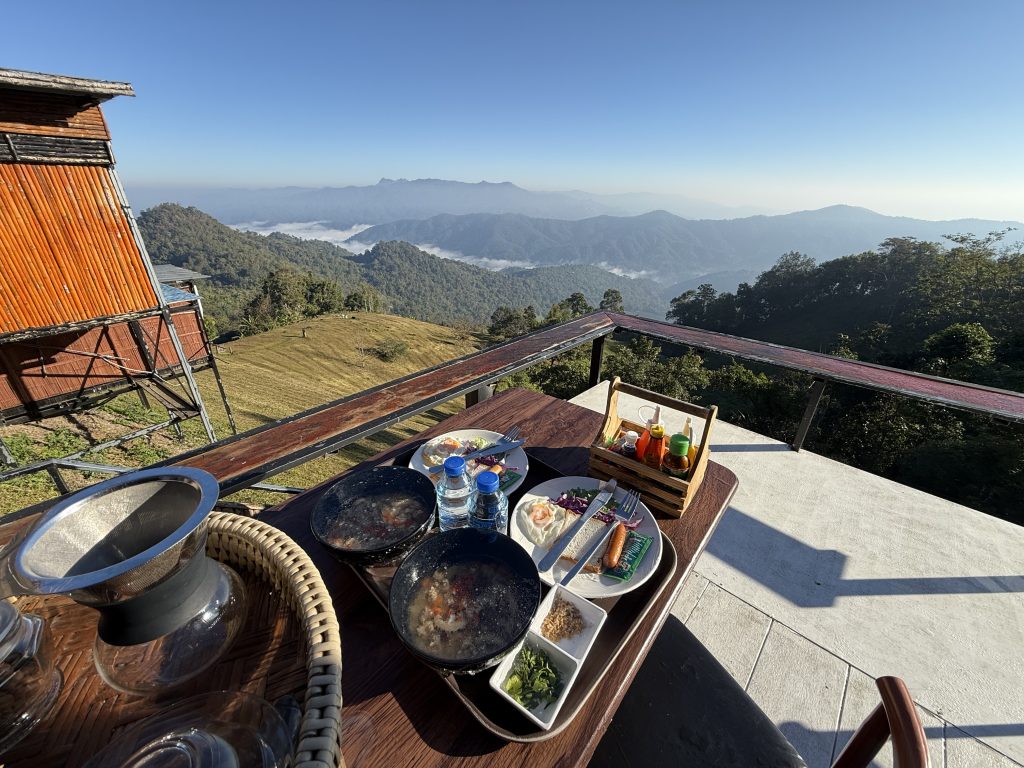
I recently hiked on Doi Inthanon in Chiang Mai, Thailand’s highest mountain at 2,565 meters.
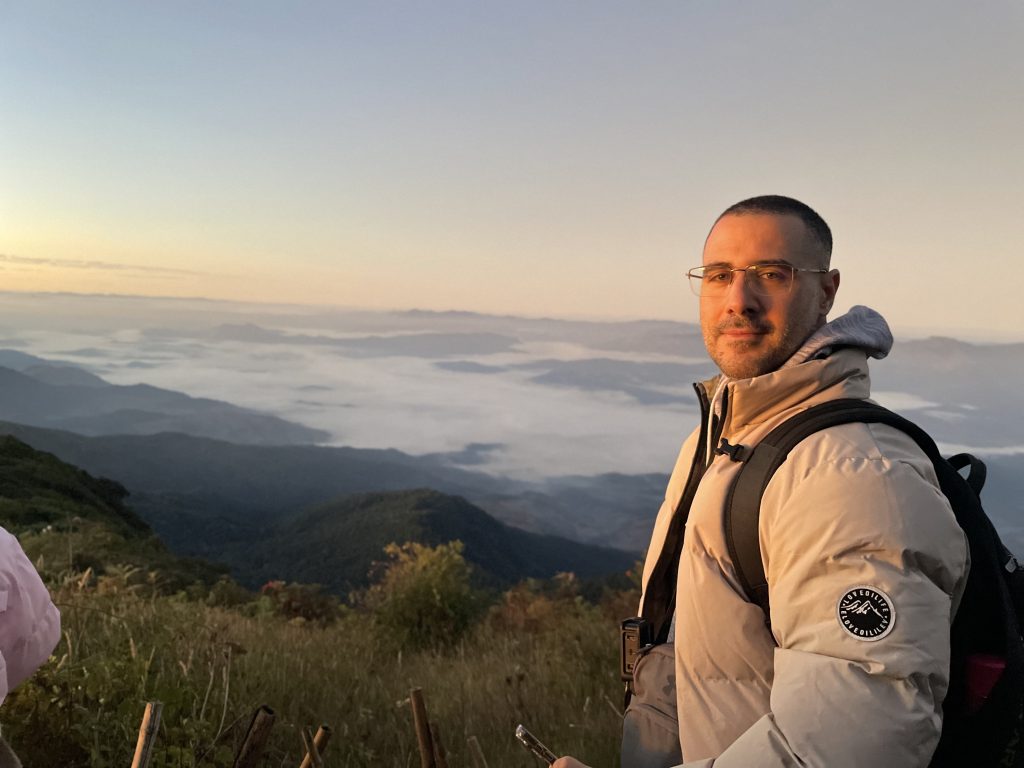
I have stood there. The air is crisp and clean. My eyes could finally focus kilometers into the distance instead of 50 centimeters. The horizon was real. The sunlight was full-spectrum. At night the sky was so clear I could see thousands of stars with my own eyes.
The biological reality is:
- Real sunlight regulates hormones.
- Real distance relaxes the nervous system.
- Real air and real horizons keep the mind sane.
This is the kind of digital detox and freedom I chose instead of the multi-planetary dream.
I didn’t move to Southeast Asia to take a break. I came here to do the exact opposite: reclaim the hardware-software interface that actually makes us human, namely the sun, the sea, the mountains, and control over my own vitals without any central authority holding a kill-switch.
I even have plans to build a small sovereign homestead in Thailand where I own my water, my food, my energy, and my time.
The Bottom Line
If you are not sovereign here on Earth, if you do not control the air you breathe, the water you drink, and the ground under your feet, you will not magically become free on the Moon or Mars.
You will simply trade one set of masters for another.
The Lone Stack is not about escaping to another planet.
It is about securing this one through real sovereignty and freedom.
Technical Intelligence Annex
[01] Biological Decay & Gravity Thresholds
NASA NTRS 20070001441 confirms that missions exceeding 6 months in low-G result in significant bone density loss and cardiovascular deconditioning.
[NASA NTRS 20070001441]
[02] Hardware Failure: Regolith Abrasiveness
NASA NTRS 20050160460 documents Apollo 17 crew struggles with mechanical seal failures caused by jagged, electrostatically charged volcanic shards.
[NASA NTRS 20050160460]
[03] Shielding Mandates: Radiation Management
GCR mitigation requires 2–5 meters of regolith burial. Insufficient shielding creates secondary particle cascades, increasing lethal exposure.
[NASA NTRS 19910008686]
[04] Respiratory Toxicity: Perchlorate & Silica Protocol
Martian regolith contains carcinogens and perchlorates. Inhalation of shards leads to pulmonary fibrosis and thyroid dysfunction.
[NASA GeoHealth 2025]