If you treat your physical body as your core system, the underlying physical hardware that supports every digital, financial, or sovereign project you build then documenting your training is a non-negotiable diagnostic tool.
But there is a massive problem: the camera industry is not building tools for you. It designs exclusively for mass-market lifestyle vloggers, beauty creators, or extreme-sports tourists.
If you are a solo operator looking for the best camera for recording gym workouts without turning a public gym into an invasive, high-footprint production set, you are fighting a losing battle against optical physics and specifically wide-angle distortion in workout videos.
Here is the objective reality of why the “perfect gym camera” is a structural myth, and how you can engineer a high-caliber workaround using pure geometry.
The Gym Recording Trilemma
When choosing a camera for the gym, you are forced to balance three conflicting variables. Physics only allows you to select two.
| Parameter | The Goal | The Failure Point |
| 1. Muscle Compression | Proportions look dense, thick, and realistic (50mm lens compression). | Requires placing the camera 3 to 4 meters away, blocking public pathways. |
| 2. Full-Body Framing | Capturing full mechanics (squats, pulls) from close range. | Requires an ultra-wide lens, which flatlines your muscle volume and shrinks your limbs. |
| 3. Stealth Footprint | Small, solid-state, fast setup without tripods or heavy rigs. | Forced to use fragile gimbals or blind-framing setups that complicate the session. |
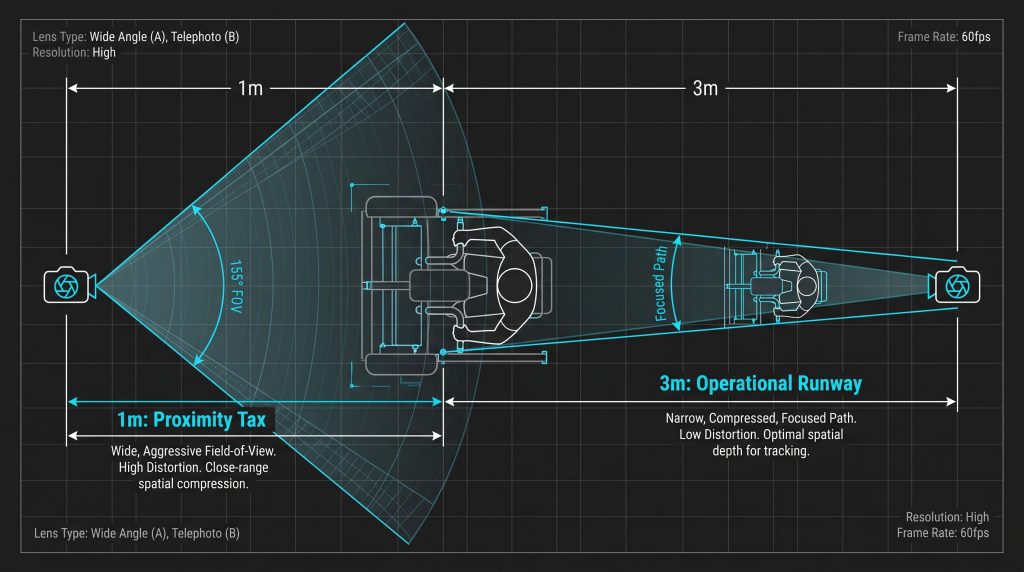
If you optimize for a small, magnetic footprint (for example an action camera like a DJI Action 6 Pro), you pay the proximity tax. If you optimize for realistic muscle rendering (like a portrait setup), you pay the logistical tax of setting up a massive 4-meter perimeter in a shared space.
The Optical Trap: Why Your Camera Shrinks Your Progress
Action cameras are engineered for extreme field-of-view coverage. Physically, their glass lenses are ultra-wide equivalents (typically 12mm to 15mm).
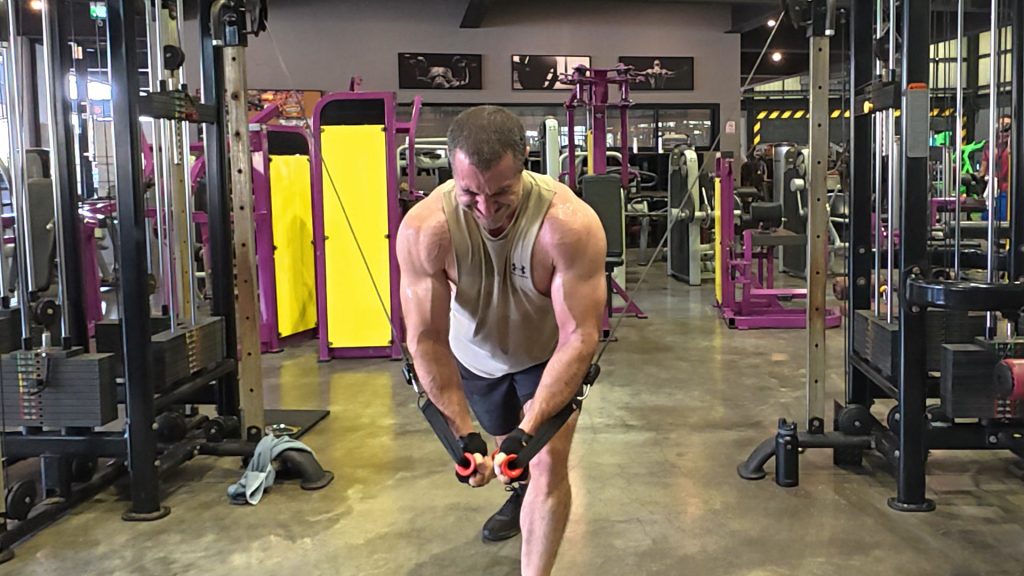
When you mount these cameras at close range which is typically 1 meter or less, like directly onto a cable machine or overhead rack then the perspective distortion goes to war with your physique.
- The Distance-Ratio Problem: In wide-angle optics, objects closest to the lens look disproportionately large, while anything moving away shrinks exponentially.
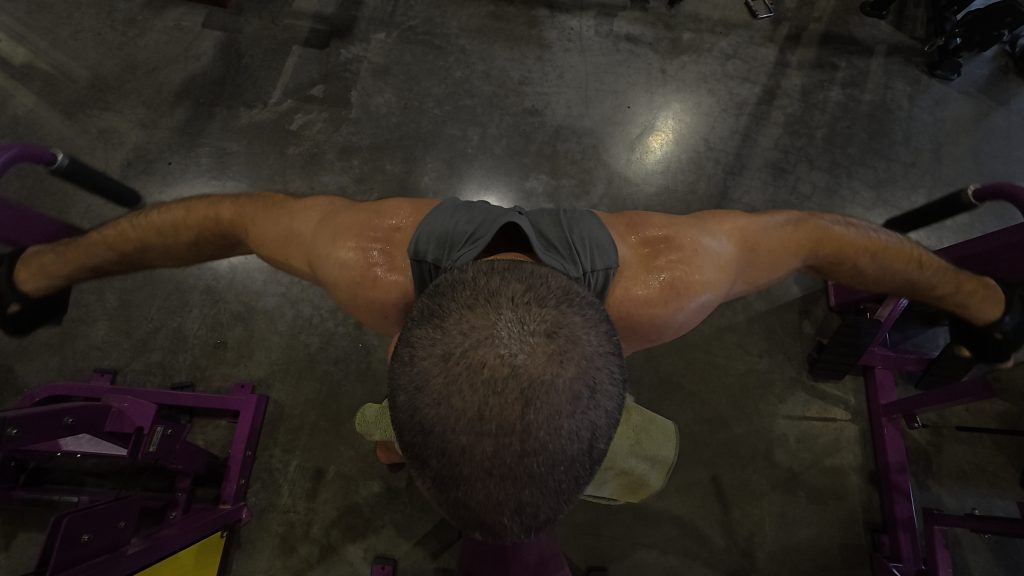
- The Overhead Collapse: If you mount a wide-angle camera ~0.5 meters above your head during a machine reverse fly, your head look massive because they are closest to the glass. Your arms and shoulders extend downward, pushing them ~1 meter away. Physically, they look half their actual size on screen.
- The Flattening Effect: Even in “standard” dewarp modes, a wide-angle lens cannot fix 3D perspective depth. It flattens your muscle volume into a 2D plane, leaving you looking flat, narrow, and untrained.
The Mechanical Trap: Why Gimbals Are a Gym Liability
The obvious industry alternative is a compact 3-axis gimbal camera (like a DJI Pocket 4). These use mechanical stabilization, allowing for narrower 20mm lenses and larger sensors that create genuine depth and background separation.
But in a high-load gym environment, a mechanical gimbal is a high-risk structural liability.
- High-Frequency Shockwaves: When you attach a magnetic mount directly to a heavy leg press or cable station, every slamming weight plate sends a violent, high-G kinetic shockwave through the steel frame.
- Motor Burnout: Unlike a solid-state action camera, a gimbal relies on delicate, floating brushless motors. Subjecting these motors to constant micro-vibrations forces them to work at maximum capacity to stabilize the frame. Over time, this wears down the internal components, causing sensor drift or terminal motor failure.
- The Durability Deficit: A gym is a chaotic environment. One dropped dumbbell or a magnetic mount slipping off a slick column will instantly snap a gimbal arm, bricking a $400+ asset.
The Tactical Workaround: Defeating Physics in Post-Production
Since the perfect gym hardware does not exist, the solution is not to buy more gear. The solution is to change your geometry and let software do the heavy lifting.
If you are using a solid-state, indestructible action camera (like the DJI Action 5 Pro or Action 6), you can bypass wide-angle flattening without expanding your physical footprint into a 4-meter hazard zone.
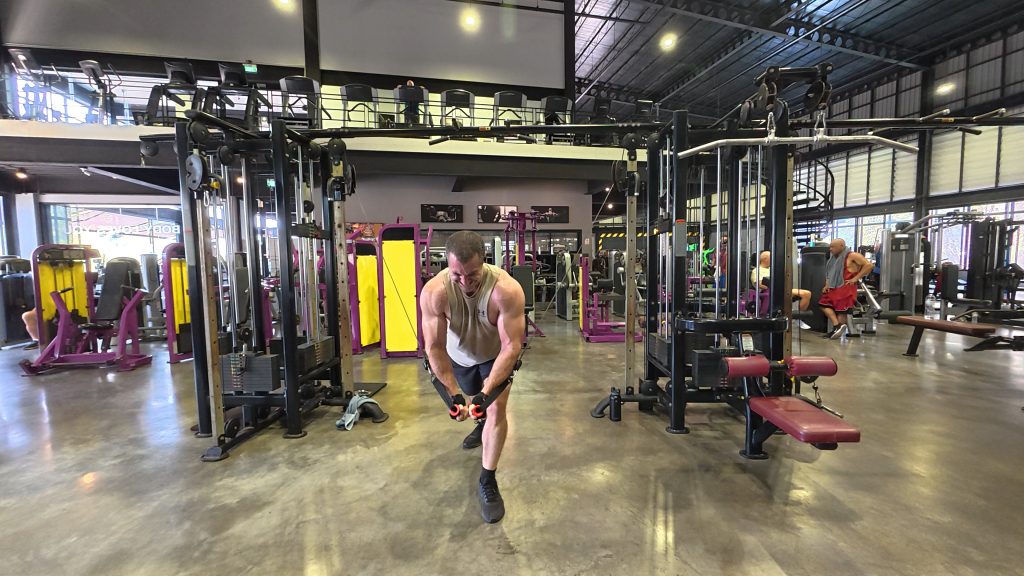
- Increase the Distance to 2.5 Meters: Move the camera off the machine you are operating. Snap the magnetic mount to a stationary steel pillar or adjacent dumbbell rack 2.5 to 3 meters away.
- Utilize the 4K Sensor Resolution: By standing further back, the perspective distortion disappears, and your natural 3D muscle thickness is restored.
- Crop 1.5x in Post-Production: In your video editing suite (like DaVinci Resolve), crop the frame. A 1.5x zoom on a high-bitrate 4K file keeps your final output sharp for social media screens while giving you the exact background compression of a professional lens.
The Operator’s Protocol
Pleasing everyone in a shared space is a system failure. The math doesn’t work. The protocol is simple: optimize for the environment, accept the physical limitations of the glass, and keep the footprint clean.
I show up, I respect the environment, and I get the work done. The rest is just logistical noise.