When I first moved to Thailand and dove into intensive training, heavy lifts, boxing, and Muay Thai, the environmental reality hit me hard. I knew about pollution in Bangkok, but nothing prepared me for the physical friction of breathing that air while pushing my limits every day.
When you mix it with the severe heat and humidity, the air becomes a physical weight in your lungs. I was used to summers back in my home country with temperatures up to 40C, but nothing compared to the climate here in Southeast Asia. It feels very different, I would describe it as thicker, heavier, and far more draining when you are trying to train hard.
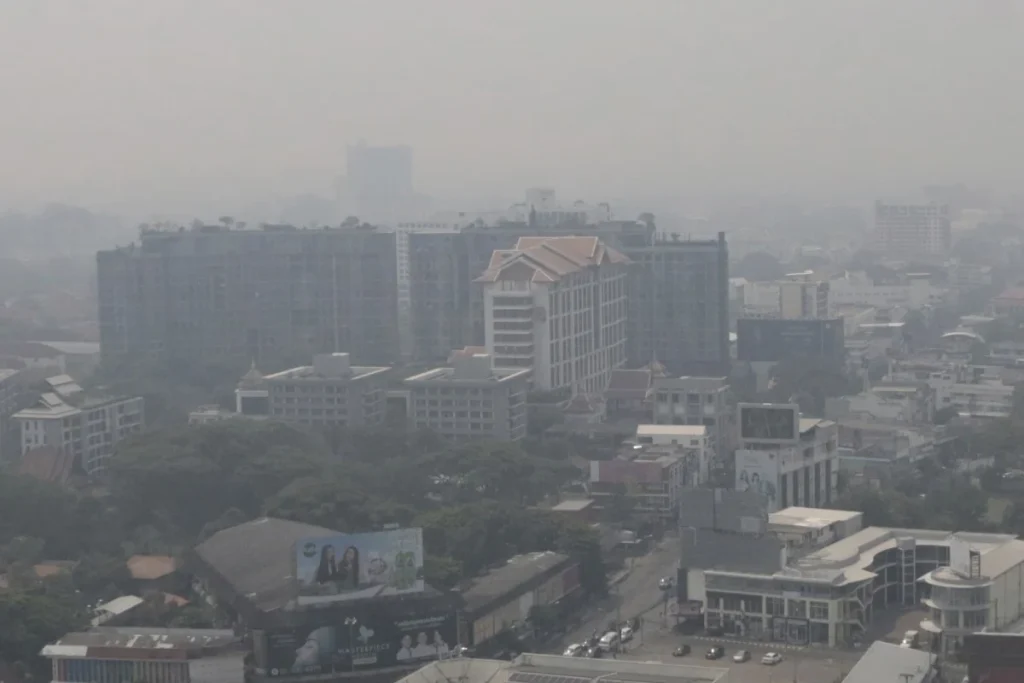
What Is Thailand’s Burning Season and Why Is the Air So Toxic?
Every year from roughly late December through April or May, farmers across Thailand, especially in the northern regions like Chiang Mai, burn massive amounts of crop residue, mainly sugarcane and maize, to clear land for the next cycle. This agricultural burning, combined with dry season forest fires from Thailand, Myanmar, and Laos, creates a thick regional haze loaded with PM2.5 particles.
These microscopic particles, 2.5 microns or smaller, bypass your lungs’ natural filters, enter the bloodstream, and trigger widespread inflammation[01]. For a young 20-year old the effects might feel minor. But past 35 the biological drag becomes obvious. Many older expats and locals deal with reduced respiratory capacity and chronic fatigue during these months.
How Toxic Air Downgrades Hard Training
When you are lifting heavy or going hard in Muay Thai rounds, your oxygen demand explodes. You pull in far more air and far more inflammatory PM2.5 particles. The resulting inflammation bottlenecks oxygen delivery to the muscle tissue. The result is systemic fatigue. You gas out faster, lose explosive power, and cannot sustain the same volume or intensity you normally handle.
That was my reality during my first burning season. Some days the cardiovascular friction was so high I could not make it past 20 minutes of hard training without my lungs burning and energy crashing completely.
Why Locking Down Was Not an Option for a Sovereign Expat
The government advises vulnerable people to stay indoors with windows closed and run air purifiers. That is standard protocol for the masses. But operating from a sovereign mindset means not letting environmental chaos dictate physical output. Pausing my training to hide inside was never a viable option.
So I started researching the biological mechanics and testing solutions on my own “hardware”.
My 3 Part Biological Stack for Training in Polluted Air
IMPORTANT DISCLAIMER: This is NOT medical advice. I am sharing the exact protocol that worked for me after securing full bloodwork and clearance from my doctor. Always consult a physician before introducing any compounds to your system, especially prescription ones. Do your own research and get proper tests.
After testing and refining, I settled on this 3 part stack, which I have now run successfully for two full burning seasons. It reduced the respiratory drag significantly and allowed me to sustain heavy lifts and high-volume combat sports without the usual systemic crash.
Here is the exact architecture:
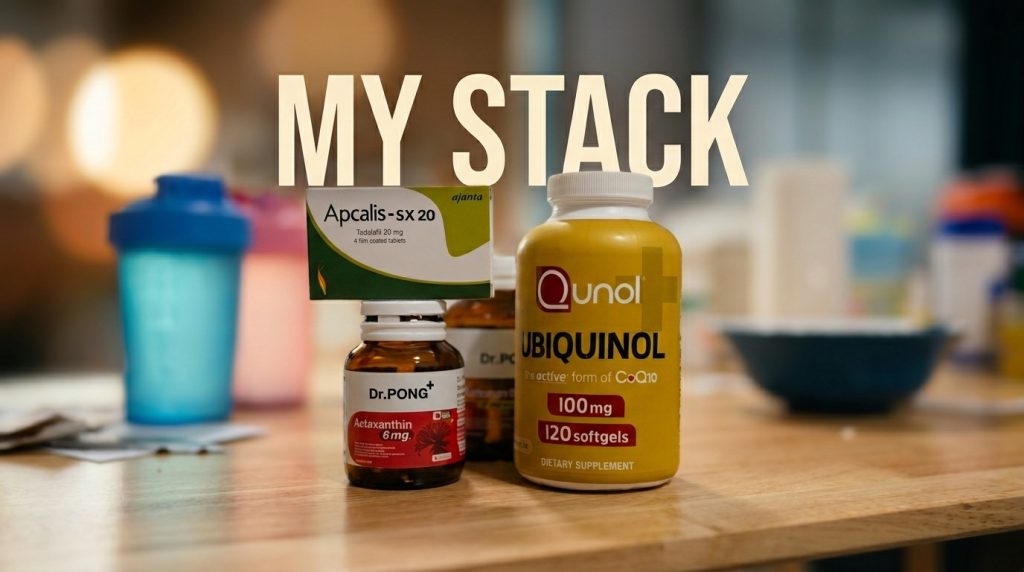
- Astaxanthin: One of the most potent natural antioxidants. It helps neutralize the oxidative stress and cellular inflammation caused by inhaling heavy PM2.5[05].
- Ubiquinol (Active CoQ10): This directly fuels the mitochondria, the cellular energy factories. When environmental inflammation drags the system down, Ubiquinol keeps the power on. I specifically look for the Kaneka trademarked version for guaranteed quality.
- Low Dose Tadalafil (Generic Cialis, 2.5 to 5 mg): This is the unconventional override. At micro doses it acts as a powerful vasodilator. It widens blood vessels, improves blood flow, lowers pulmonary pressure, and delivers more oxygen rich blood to the muscles despite the toxic air.
Clinical & Off-Label Note: Tadalafil is clinically proven to improve pulmonary blood flow and exercise capacity in patients with pulmonary arterial hypertension (PAH) through selective PDE5 inhibition and vasodilation of the pulmonary vasculature[06].
However, my use at micro-dose (2.5–5 mg) for training in heavy PM2.5-polluted air is completely off-label and based solely on my personal results and self-experimentation after medical clearance. It is not a proven or approved application for healthy individuals.
If this stack helps you keep training through the haze and you want to support independent, sovereign content like this, you can send some crypto or buy me a coffee!
XMR: 8Af3UaLLAc2c9A9gd9UFP3cqAXcmkkVMC4iDhU2xmW5xQuaNGUZVwRoLFToxpFmKcLjWKGtq6mmNYAoryDzEavHp4cfPQNf
BTC: bc1qgra7ulegx2kzyc67qw6qf5mct230273xv4eckd
Buy me a coffee or moreMaximizing Absorption Via The Lipid Carrier Mechanism
Astaxanthin and Ubiquinol are fat-soluble. If they are introduced into an empty stomach or taken with water alone, the system cannot efficiently pull them through the intestinal wall, resulting in a massive loss of the compounds.
To maximize bioavailability I always take them with a high quality Omega-3 fish oil or a high fat meal[03]. The dietary fat acts as a transport vehicle so the compounds actually reach the bloodstream instead of being flushed out.
Why I Choose Ubiquinol Over Regular CoQ10
Standard CoQ10, known as Ubiquinone, is the cheaper oxidized form. The body must convert it into the active form before it can be used. Under heavy oxidative stress from PM2.5 this conversion becomes inefficient. Ubiquinol skips the conversion bottleneck entirely and enters the system ready to fuel the mitochondria[02].
Tadalafil Timing and Why the Long Half-Life Matters
Tadalafil has a long half-life of 17 to 36 hours, unlike shorter acting vasodilators that spike hard and then crash[04]. This allows for steady state benefits. I take a micro dose before sleep or every 48 hours. The cardiovascular pathways stay optimized for high physical output the next day without needing perfect timing.
Critical Dosing Warning: I stick strictly to 2.5 mg to 5 mg. Higher recreational doses (10 mg or more) can cause severe tension headaches, sinus congestion and muscle pumps in the lower back and calves that destroy mobility during any kind of training and especially Muay Thai or boxing. At micro doses the compound improves endurance and oxygen delivery without those “system failures”.
Frequently Asked Questions
Do you need a prescription for these compounds in Thailand?
Astaxanthin and Ubiquinol are over the counter and widely available at pharmacies or on platforms like Shopee and Lazada. Tadalafil is regulated. While some pharmacies sell it informally, the safe and proper protocol is to consult a local doctor or clinic first to ensure your cardiovascular system can handle the vasodilation.
When is the best time to take the stack?
I take Tadalafil before sleep because of its long half-life. Astaxanthin and Ubiquinol go with a high fat meal or Omega-3 fish-oil for optimal absorption.
Does low dose Tadalafil cause pumps that interfere with Muay Thai?
At 2.5 mg to 5 mg it generally does not. The paralyzing muscle pumps only appear with much higher doses. Strict micro dosing keeps the benefits for oxygen delivery while preserving full mobility.
Does this stack replace the need for an air purifier?
No. This stack is a patch for physical output when I train outside. For recovery I still run HEPA air purifiers indoors, especially while sleeping. The combination gives the best results.
Are there side effects?
At proper doses Astaxanthin and Ubiquinol are highly tolerable for most healthy individuals. Tadalafil at micro doses is generally well tolerated but remains a potent pharmaceutical. Overdosing can trigger tension headaches, water retention, sinus congestion, or muscle pumps that can paralyze training. Strict dose control is non negotiable
The Final Output
This specific stack bridged the gap for my “hardware”. It allows me to maintain my daily physical execution and training sovereignty instead of retreating indoors when the environment degrades. If you are training in Southeast Asia and feeling the same physical drag, researching these mechanics with proper medical guidance is a logical step.
Stay strong and stay sovereign out there.
Technical Intelligence Annex
[01] Environmental Friction: PM2.5 Infiltration & Systemic Inflammation
The American Heart Association (AHA) confirms that fine particulate matter (≤2.5 microns) bypasses respiratory filters, causing oxidative stress, systemic inflammation, and cardiovascular bottlenecks.
[AHA Circulation Journal]
[02] Cellular Energy: The Ubiquinone Conversion Bottleneck
NIH clinical data demonstrates that the biological reduction of standard CoQ10 (Ubiquinone) to its active form (Ubiquinol) degrades significantly under the heavy oxidative stress caused by environmental pollutants.
[NIH StatPearls Data]
[03] Bioavailability: Lipophilic Transport Mechanics
Clinical pharmacokinetics mandate that highly lipophilic antioxidants like Astaxanthin require a dietary lipid transport vehicle (e.g., Omega-3) to facilitate micelle formation and ensure intestinal absorption.
[NIH PMC Research]
[04] System Overload: Tadalafil Pharmacokinetics & Hardware Failure Modes
FDA prescribing documentation verifies the 17.5-hour half-life of Tadalafil and explicitly warns that high doses trigger systemic failures, including severe myalgia (muscle pumps) and tension headaches.
[FDA Prescribing Information]
[05] Cellular Defense: Astaxanthin vs. PM2.5 Oxidation
NIH clinical documentation confirms that Astaxanthin acts as a highly potent scavenger of reactive oxygen species (ROS), directly neutralizing the pulmonary inflammation and oxidative tissue damage triggered by PM2.5 infiltration.
[NIH PMC Research]
[06] Tadalafil in Pulmonary Arterial Hypertension
The PHIRST trial demonstrated that tadalafil (10–40 mg daily) significantly improved 6-minute walk distance, hemodynamics, and delayed clinical worsening in patients with pulmonary arterial hypertension via pulmonary vasodilation. [PMC Review of PHIRST Trial]
If this helped you, consider sending some crypto or buying me a coffee!
XMR: 8Af3UaLLAc2c9A9gd9UFP3cqAXcmkkVMC4iDhU2xmW5xQuaNGUZVwRoLFToxpFmKcLjWKGtq6mmNYAoryDzEavHp4cfPQNf
BTC: bc1qgra7ulegx2kzyc67qw6qf5mct230273xv4eckd
Buy me a coffee or more