This summer marks exactly ten years since I executed my first trade. It was a one-hundred-dollar account running on a lagging web platform. I didn’t even know the difference between a limit and a market order.
A decade later, I am not standing here claiming to be a multi-millionaire market wizard. I trade part-time alongside managing my consulting business. I don’t look for predictable, smoothed-out monthly payouts from a volatile environment. I take my wins, accept my calculated losses, and focus entirely on execution precision.
I write here to break down the stereotype that is promoted online claiming that a couple of years suffice before profits begin and the account grows rapidly. I classify this as a constructed myth that sustains marketer distribution of content and products while hiding the fact that long-term market execution requires permanent psychological adaptation rather than quick financial hacks.
The reality is the exact opposite of what the industry sold you.
Why I trade
I entered this space with the same attitude that 99% of the people start with: I wanted to make money.
The reason I stayed, though, despite what many would call “failure”, is that I realized the true meaning of what trading is and what it really means to me.
Fundamental Truths About Trading
Trading is not just another business or industry; it’s a transformational skill set for one person. I would call it a foundational skill, as it can last for a lifetime. As long as my brain and body are healthy, I can trade.
It is also intellectually engaging, a necessary constraint for long-term focus. It forces constant cognitive processing, preventing the mental drift that comes with executing repetitive, automated tasks. The market is not a constant element; it evolves and changes constantly, and it has cycles. All of that is heavily documented.
If I were to even start getting bored with traditional trading, for example, I could jump into other areas of trading to satisfy my hunger for knowledge and intellectual stimulation. For instance, if I started learning about quantitative trading, as I am already 45 years old, the rest of my lifetime would not be enough to digest all the knowledge that is out there and understand it. Statistics, advanced mathematics, low latency optimization, custom software, the list goes on.
Trading means I rely on myself for everything. There is no one else coming to help me, nor do I need anyone to make the choices for me. It is a sovereign trait, you either master yourself or get wiped out by your own doing, meaning you will burn out all your capital and essentially zero out.
Personal Requirements
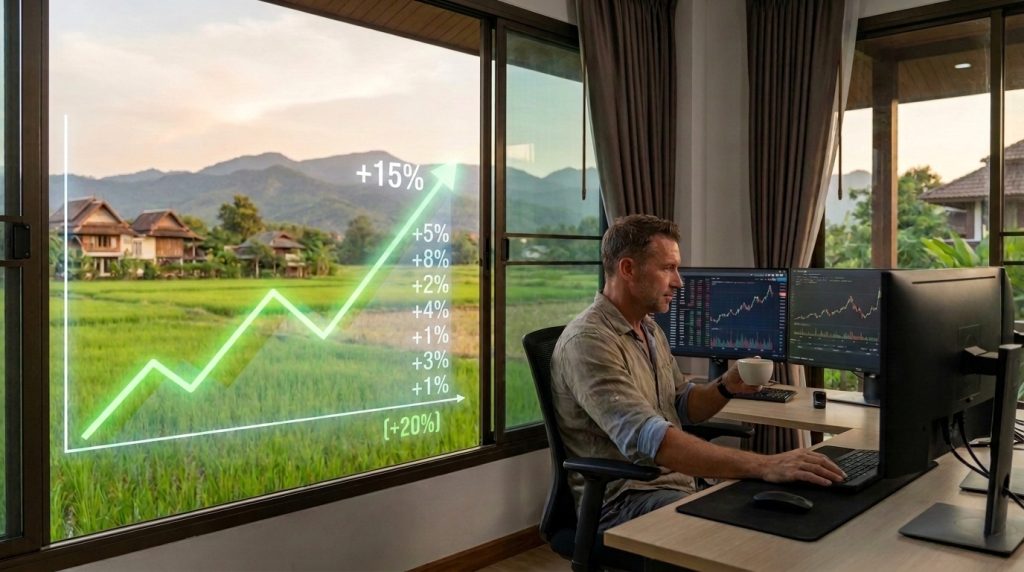
After years of being a freelancer, having my own company and working completely remotely, I know I am never going back to a normal working environment, that would be the end of me as a sovereign and freedom seeking individual.
I would say that in my life I have gone full circle, from having no money and working a 9-to-5 job to having lots of money, doing business, and losing almost all of it. This gave me perspective and helped me understand myself and define my life objectives as I started rebuilding.
I chose to continue with trading as part of a highly selective list of pursuits that fit a strict set of requirements:
- Location independent. I can trade from literally anywhere in the world. I can change countries if needed. If I want to go live in the Philippines in the jungle, I just need a small solar-based installation and a Starlink subscription.
- The upside is structurally uncapped. There is no limit on how much money you can make or what size account you start with. You can trade with a $250 account or a 7-figure one; the only thing that changes is the market and execution strategy.
- No trading restrictions. No one can stop me from executing my trades. As long as I don’t do something illegal, I am allowed to trade. Even if the requirements get super strict in the future, there are so many markets, like crypto, that will always be open to anyone, not to mention new ones that may emerge in the future.
My Trading Exit Strategy
My exit strategy from my personal trading endeavors is that I do not wish to exit.
There are a large number of self-proclaimed successful traders who, despite their success, preach about exiting and retiring, and most commonly suggest investing in and starting a “real” business. I personally see it as a fallacy.
Why would I trade a skill that grants me absolute personal autonomy just to buy myself an office, a calendar full of meetings, and endless corporate stress? This is the exact thing I am actively trying to avoid.
Trading is a path that can lead to freedom and sovereignty, not slavery and stress. But it’s a personal decision on what destination your path will reach.
Making Money VS Achieving Sovereignty
I am not a slave to money, nor am I bound to the outcome of any single position. I am an autonomous individual working toward absolute personal sovereignty, which is a lifelong pursuit.
In my technical guides, I talk extensively about digital sovereignty; leveraging Linux, OpenBSD, and open source to liberate my hardware and software from Big Tech. Trading is the exact parallel for my financials. It is the protocol to liberate my life from the corporate world.
Fake Freedom
The trading industry is also full of the word “freedom”. Everyone talks about how trading will make you free, while they portray freedom as owning luxury items, running around in expensive places burning money, or conversely selling you their courses, indicators, and strategies, while portraying themselves as humble. The industry has food to feed any psychological appetite, and in my experience it tries to embed in any trader the definition of freedom as a dependency on a master, be it an indicator, a “coach”, a signal service, endless content, or even the pursuit of a Lambo.
The Plato’s cave allegory is the perfect concept to describe what is happening, and when you understand it and see it, you cannot unsee it, ever.
They want you to focus on the shadows so you never escape into the light.
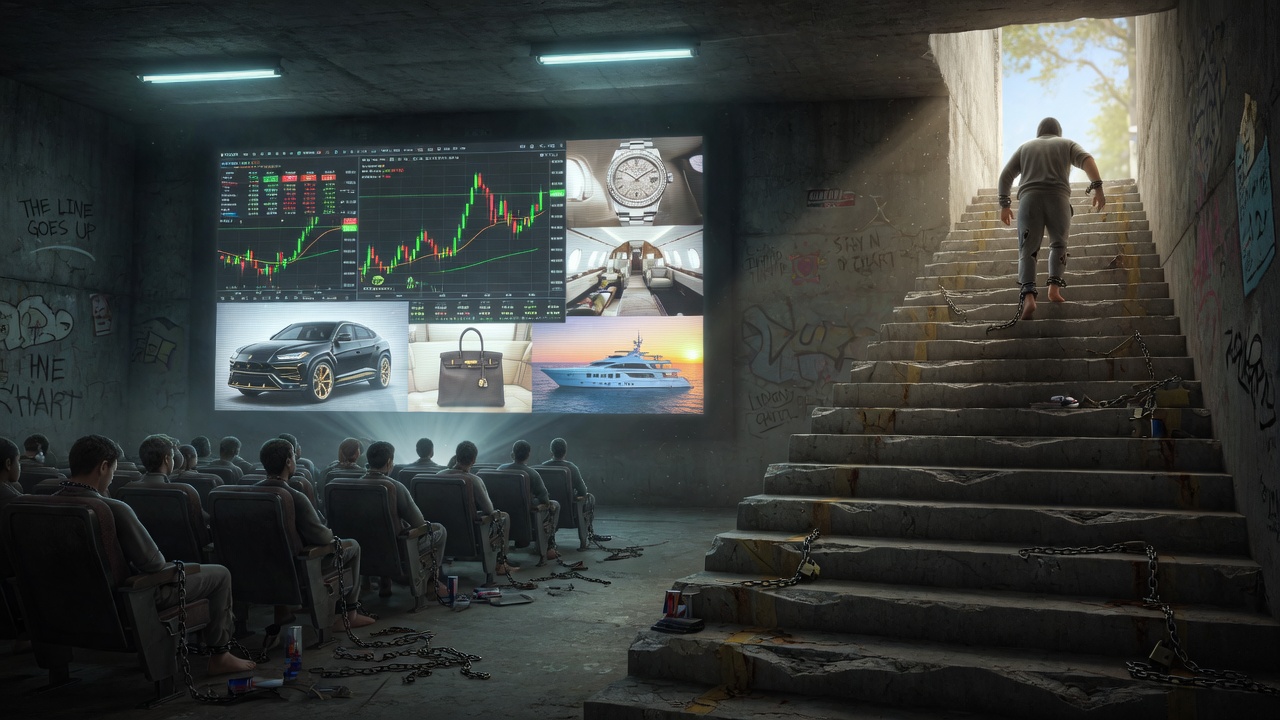
The industry lays before you a variety of objects so that you forget the chains they lock you down with. The psychological aspect of that is something very deep inside each and every one of us. Speaking for myself, I fell for that in the first years. For me, the trap was a flawed expectation of how quickly a statistical edge could be mastered.
You see, the tricks are endless. If someone is not lured into opening a $50k account and starting to lose all his money, the industry has so many ways to trick him into oblivion; from what initially worked for me, thinking I could be profitable fast, to things like believing that there are “coaches” to rely on or even big trading desks that will give you the social feeling that you belong somewhere.
The reality is unforgiving. Trading is a sovereign, lonely profession. You need to master yourself and be comfortable with being alone. This is the only way I found to really liberate myself from the shadows and see the real freedom trading can provide.
The Industry Reality in 2026
As I write this in 2026, the industry is well-structured with perfectly placed traps to keep everyone dependent and focusing on the only thing that matters less: money.
I see two big traps that exist, and they are surely the biggest threats to one’s real evolution from a money-seeking zombie to a free and logically thinking sovereign trader.
The Prop Firms Trap
For a few years now, the rise of Prop Firms and “evaluation” programs has remained large in 2026. This is not a coincidence. It happens because they provide the illusion of supplying capital to undercapitalized individuals while also offering a way to multiply profits by having multiple accounts that you can copy trade across. They attract both the greedy and the desperate. Genius, isn’t it?
They introduce monthly fees and several restrictive rules, while making you work for them as an individual contractor and literally forcing you to set your own goals to achieve continuous payouts that follow their strict rules.
This is the exact definition of a person who is not free, but chained down, inside the cave:
- You are not free to make your own choices.
- You are not free to withdraw whenever you want.
- You do not own the account.
- You split profits with them while also paying fees.
- You trade in a demo account.
How much sovereignty do you actually possess when you must obey someone else’s rigid parameters just to secure a payout? Is that freedom? Or is it the exact same corporate slavery of a 9-to-5 job, just with a digital dashboard instead of a boss breathing down your neck?
The Luxury Loop
The lifestyle portrayed by all these online marketers binds your trading execution to high-ticket consumer buys. There are also levels of luxury. This is another psychological thing that no one talks about.
For you, luxury might mean owning a Lamborghini, but for the person next to you, it could mean walking to a supermarket and buying food without looking at the price tag.
Understanding the above statement is critical to seeing how everyone plays to a different audience, pushing content and software down their throats that they either need to pay for or just watch in massive numbers so that marketers can be paid through ad placements.
Also don’t misunderstand my position: I am not anti-luxury. I am anti-dependency. I have lived that lifestyle before. I know firsthand that instead of liberating you, it forces you to make more money to buy more things you do not actually need.
This loop has no built-in exit condition. Furthermore, if anyone brings that mindset to trading, they can become emotionally compromised, over-leverage, chase trades, and eventually blow up their capital trying to fund a lifestyle that doesn’t serve freedom.
My End Game
I don’t focus on wealth accumulation for the sake of status. I build skillsets. Skillsets that secure my independence—free of corporate bosses, completely self-sufficient, and time-independent. I build skills that render other people’s opinions entirely irrelevant to my life choices.
Trading is the ultimate enabler of that exact framework. The money isn’t the trophy. It is simply the battery that keeps the infrastructure of my freedom running.
It is a tool to sustain autonomy and keep me out in the light.
If you found this article useful, consider supporting my work. Buy me a coffee, fund some egg whites, or help offset the server hosting costs to keep this stack independent and entirely ad-free.
Buy Me a Coffee / Support My Work
Great content! Keep up the good work!