
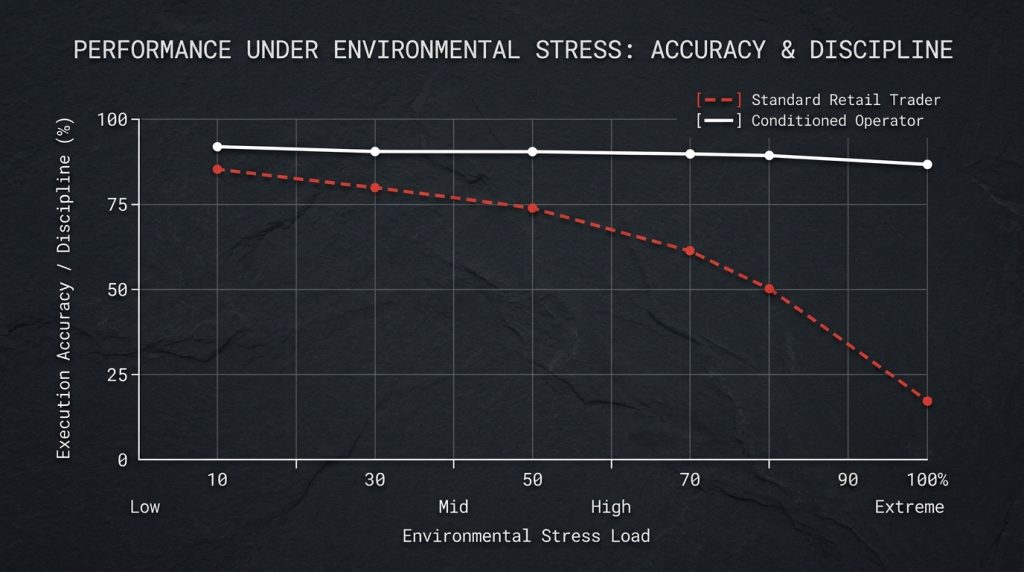
Most retail traders approach the market as a library. They read books, watch “guru” streams, and attempt to draw cleaner lines on a chart. They fail because they define discipline as a knowledge problem. It is not. Discipline is an infrastructure problem inside our central nervous system.
If you are struggling with your day trading psychology, you are not failing just because you lack strategy. You are failing because your neural hardware is conditioned to fire in the wrong sequences. You are training yourself to fail.
This is a technical debrief on how I used the high-stress architecture of Aliens: Fireteam Elite game to debug my own brain, rewire my dopamine receptors, and stabilize my market execution through a systematic stress-test.
1. The Variable: What is Trading Psychology?
The question “what is trading psychology” is usually answered by fluff-peddlers with abstract concepts about “mindset” and “emotional control”. That is irrelevant.
From a systems engineering perspective, trading psychology is simply the signal-to-noise ratio of your internal feedback loop. When you trade, you are a biological processor. Your input is price action and order flow; your output is a decision. If your hardware is conditioned to chase dopamine spikes -a common side effect of modern mobile-app trading- you will inevitably experience analysis paralysis and execution failure during high-volatility events.
I learned that to improve my performance, I must stop treating trading as a math problem and start treating it as a neural infrastructure problem. I needed a controlled environment to stress-test my biological hardware.
2. The Laboratory: Aliens Fireteam Elite as a Training Arena
I did not play Aliens: Fireteam Elite because I was bored. First I played it because of my long-term affinity for the Aliens franchise and I continue to play because the achievement architecture is a brutal, high-fidelity simulator for impulse control.
There is a distinct difference between “gaming” for entertainment and gaming for neural conditioning.
- The Trap (Mindless Gaming): Most First-Person Shooters (FPS) are designed as dopamine loops. They reward high-velocity, low-consequence input. They condition your brain to prioritize reflex over strategy. For a trader, this is active sabotage.
- The Tool (Strategic Gaming): Aliens: Fireteam Elite on “Insane” difficulty imposes strict constraints. It forces a 3-player team dynamic where friendly fire is enabled. If you shoot a teammate, you delete their health and effectively sabotage the mission.
This is the exact parallel to day trading psychology. In the market, a single “panic shot” (unforced trade error) destroys your allowed daily drawdown, especially if you are day trading or scalping. The game forces you to internalize the consequence of every bullet.
3. Diagnostic: Dopamine Management in Trading
Retail platforms often rely on variable reward schedules to keep you addicted. You click, you see a green flash, you get a hit. This is dopamine management in trading gone wrong.
In Aliens: Fireteam Elite, a mission takes on average 30 minutes of flawless execution. If your team makes an error in the final room, you reset to zero. There are no “partial wins”. This brutal architecture forces your brain to stop hunting for the immediate, low-value spike and instead prioritize long-term, high-value success.
By playing this environment, I reindexed my dopamine receptors. I stopped expecting immediate validation from every tick and started focusing on the 30-minute deployment of my strategy. This is mastering trading psychology at its best, shifting from a hunter-gatherer mindset to a system-operator mindset.
4. The Correction: Impulse Control and Market Execution
“Itchy trigger finger” is the most common cause of retail account blowouts. It is the literal manifestation of impulse control failure.
In the game, an enemy is often right in front of your face. You have the reflex to pull the trigger. But your teammate is crossing your line of sight. If you fire, you lose. You are forced to physically hold the mouse still. You must bypass the impulse, roll back, and wait for the precise structural alignment of the firing lane.
When I translated this to my trading desk, the physical memory remained. Now, when a candle spikes and my system signals “enter”, I feel the same restriction I felt in the game. I wait for the counter-signals to clear. I wait for the landscape to align. This is the definition of trading market execution: waiting for the edge, not hunting for the action.
5. Multivariable Threat Tracking vs. Analysis Paralysis
As Retail traders we frequently overload our cognitive bandwidth. For example we may watch the news, check RSI, monitor 5-minute charts, and track order flow, all at once. This leads to system paralysis.
The game mirrors this load. You are simultaneously tracking:
- Remaining magazine count.
- Audio cues and enemy positions from the motion tracker.
- Teammate positioning to avoid friendly fire.
- Fallback routes.
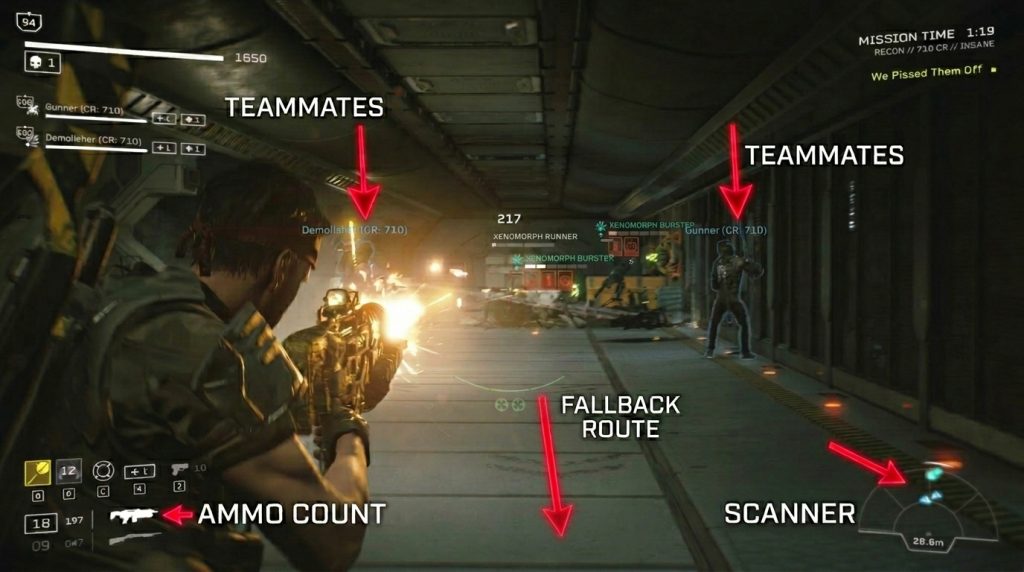
By forcing my brain to process these four data streams calmly under extreme audiovisual stress, I expanded my cognitive bandwidth. When I returned to my trading charts, the data felt “slower”. I was no longer reacting to noise; I was processing a structured environment. This is how you defeat analysis paralysis. You increase your processing capacity until the environment that once felt “fast” feels manageable.
6. The Lone Stack Protocol: Personal Sovereignty and Trading
Personal sovereignty trading is the ultimate objective. You are not just trading capital; you are trading your biological hardware. If you spend your downtime conditioning your brain to react with frantic, undisciplined panic, you cannot expect to execute with cold, calculated precision when the market opens.
- Kill the wrong inputs: I eliminated all twitch-based, zero-consequence games from my routine.
- Audit your architecture: If it conditions panic, it sabotages your P&L.
- Own your environment: You choose the simulation. Choose the one that forces the discipline you need to replicate in the markets.
With Aliens: Fireteam Elite 2 on the horizon, I am already planning the next iteration of this stress-test. Not because I care about the rank, but because the architecture works. Sovereignty isn’t just about your servers or your VPNs. It’s about the nervous system that controls your execution.
Control the inputs. The outputs follow.
The Complete System: Debugging + Neural Stress Testing
This is the hardware side of the equation, conditioning your nervous system under pressure.
For the software side, identifying and debugging the actual demons (FOMO, revenge trading, self-blame) you can read the companion piece: Beyond FOMO: A Tactician’s Guide to Debugging Trading Psychology
If this guide helped you, consider supporting!
It powers more no-BS tactical guides like this.
Fuel The Stack